
Cartoonist and Illustrator Ian Marsden shows you how he drew the Ireland Football team for the new Footballheroes See Red book in Photoshop, Painter and Illustrator.

Cartoonist and Illustrator Ian Marsden shows you how he drew the Ireland Football team for the new Footballheroes See Red book in Photoshop, Painter and Illustrator.
"Très bons maillots de l'Ajax" These were the first words uttered by the French commentator Thierry Roland as the second leg of the Dutch side's UEFA Cup tie against Olympique de Marseille at the Amsterdam ArenA kicked off. He's not wrong. Ajax's basic colours and shirt design make up one of the most iconic and aesthetically pleasing strips in football history. Even when playing in Europe, such as on the night in question, and adidas are allowed to add their stripes to the sleeves (what is is about the Dutch and adidas stripes?) the white and red simple image evokes the history of this great club.
Special mention should also go to the ArenA itself. A great stadium and the shirt-coloured goal nets are surely the coolest in history - especially when bulged with an extra-time Marseille winner!
So all in order then? Ajax at home wearing their usual strip, in equal parts traditional and beautiful, l'OM - whose colours are white and blue - rightly in a change strip of gold shirts with black shirts. But why were those the kits worn the previous week when l'OM were the home side?
Blame can possibly be directed at Uefa's door. The current stipulation is that any team participating in European competition should have three playing strips. This generally results in clubs arranging with their sportswear manufacturer, or "technical sponsor", a home kit, a 2nd or away kit and a "European" or "International" third outfit.
The traditional theory is that should two teams' home kits clash then the team playing away should try first their "away" strip and then, in the unlikely event there is still an issue regarding differentiation then a third kit should be resorted to. The reality is that often even a home team can play in whichever strip the club is trying to market that week.
So we have a situation where Marseille have played two high profile matches against - in Ajax - one of Europe's greats and in neither match have they worn their colours. Last season Marseille played Liverpool at home and the teams, who could have easily played in their respective home colours of essentially all white and all red instead wore bright orange and black. I'm a huge fan of the kit l'OM wore and its tribute to the South Winners supporter group but it's still a perverse choice in that situation.
To add to the farce, l'OM (of the three kits, if you'll remember) were forced to play last season's away match at Auxerre in a change strip of the home side as the two they took to the game were deemed unacceptable - reportedly information made clear to them by the referee earlier that week. Obviously the Argentina-styled away that they were looking to play in hadn't been selling as well as they had hoped.
When Celtic released an international kit not so long ago they went with predominantly white with green and gold detail. A beautiful strip but, as Celtic play in a predominantly white home kit, about as useful as the proverbial chocolate teapot.
The fact remains that one change strip is generally sufficient - for practicality if not economics. The unwritten rule that if shirt, shorts or socks clash then the away team should change that item is rarely enforced by referees unless there is an overall identification problem. Back in Glasgow, I once dreamt that Pierluigi Collina had been drafted in to take charge of the Old Firm derby (an idea that was at one stage mooted) and his first input was to order Rangers to change their white shorts to avoid confusion with those of Celtic. I remember my anger as Rangers - inevitably in my warped subconscious - strode onto the pitch in bright orange replacement shorts and matching socks for good measure.
But I digress. The point is that when clubs play on the biggest stage they should wear their traditional and famous colours. Yes, occasionally kits will clash but in most matchups there will be a return fixture where either changing can be reversed. A third set of colours can sometimes also be required but for replica sales why can't this be the previous season's 2nd kit (as is the approach of some clubs) or a training kit? The current trend of sharing out a season's matches between three strips represents a loss of identity so if the worst comes to the worst, why not just turn the shirt inside out?
Everyone loves a good backlash. Whether it be against our work changing their staff car parking policy or our government raising taxes, even if deep down we agree with the reasoning we love to get up in arms about the decision. It works in football kit design too.
Recent days has seen the leaking and/or unveiling of several new football kits. Firstly we saw Barcelona's new pink - honestly - away shirt by Nike. It might look orange but whatever the colour it turned many people nauseous green.
adidas were then quick to get in on the act, even if it was unintentional - make up your own mind - as the world got to see the template-happy kits of Ukraine, Real Madrid, Bayern Munich and Chelsea and found they were of the same style as examples from the upcoming MLS season. That batch of strips was far from universally well-received anyway and do top European sides not deserve completely bespoke outfits?
Also witnessed have been the new Russian designs which, despite having the "rugby on bicycles" template complemented by flattering colour-schemes and traditional crests, were panned by many, and the randomly white-collared Milan shirt. The latter is a traditional shirt which doesn't keep to a new modern fit-for-all style but, again, people aren't unanimously in support.
The reaction to these shirts has been enormous. Even German newspaper Bild got their two penneth in and whilst there were encouraging comments by some, the overall common consensus was that they fell short. Damning.
But then it stepped up a notch. The new England shirt was leaked. Modern, ergonomic, futuristic, subversive, condemned. Not for a long time have I seen a shirt face so much in the way of opposition. If you have a couple of days spare then drop by footballshirtculture.com and read through the comments.
The internet might be wrong, each kit could be, as adidas say, "one of several different proposals". Certainly, the England shirt is due to be released on April Fools' Day so Umbro could be playing some elaborate prank but, all in all, I doubt it. I think the majority of these shirts will be seen on European football pitches next season and it makes you wonder how much R is going into these sportswear giants' R&D.
I hate to labour a point but, alright I love it, give it to the fans and the fans'll get it right. Fans of kit design, fans of the football teams in question, fans of football can give the input required to make a strip those exact same fans will break down the doors to purchase on the day of release. This is why so many clubs set up votes to determine which kit they'll wear each season.
The first club this season to allow input from fans (for next year's designs) was Ipswich Town back in September. Then via Coventry, Leicester and Watford we got to the recent Crystal Palace vote which even brought onboard Nike when they became The Eagles' new supplier.
But this is not a perfect system. The votes can always be sabotaged and the Watford example would have been improved by allowing fans to mix and match the shirts with shorts. It's ridiculous that the red and yellow shirt couldn't be coupled with the black shorts. Also, in the case of Palace, many supporters were angry that they had to choose between a shirt they hated and another shirt they hated, but let's not run before we can walk.
When we go to a restaurant we don't go and cook our favourite meal in the establishment's kitchen but instead we choose between expertly created dishes to find something we like the look of rather than something we can't stomach. Imagine going to a restaurant on, well, The King's Road, and being told there was no menu and no choice but to have the experimental special.

One day we may be collectively invading adidas, Umbro and Nike's kitchens and cooking up something we really like - just search the galleries on FSC and DesignFootball.com for the likes of "Chelsea" to see the potential - but until that day, just let democracy prevail.

Football stadiums aren't in short supply. If we look worldwide, every large town in every top footballing nation has somewhere for the cream of its players to perform in front of adoring (let's say) fans. A place where inhabitants of the town can go and pay to watch players perform and in some cases, people from other areas can travel to see football. This can explain why a town such as Villareal in Spain, with a population of just 50,000, can justify having a stadium that could fit half that number. Does half the town go to games? Most certainly not. People travel to see the side.
A team that has taken that idea and run with it is TSG 1899 Hoffenheim. Based in a village of three thousand, they now have a stadium that fits ten times that amount to witness their remarkable climb to the summit of the German Bundesliga. A beautiful example of modern architecture that is more than just functional. The stadium is large but not overbearing, surely inspirational and a source of pride in the region. A look and feel on the inside in keeping with modern traditions whilst looking to the future with its subtle but unmistakeably German lighting on the outside.
In some areas, however, it could be said that locals could fill a stadium many times over. This is why Club Deportivo Guadalajara - or "Chivas" - of Mexico will be shortly moving to a new modern purpose built stadium which is bizarrely based on a volcano topped with a huge cloud of dust. This will surely become an enormous place of interest (students, book your gap year now) but primarily the stadium will be able to fit up to 55,000 people. It's the kind of design that runs the risk of becoming an eyesore but the ambition can only be commended. We wait to see how it will turn out.
Even when popular demand for football isn't as large, there can be a need. As long as the funding and justification for a stadium is present then purpose-built stadia can arise. In Sweden we see a modern, simplistic and classy approach being taken with the new home of IFK Göteborg (as well as GAIS Göteborg and Örgryte IS) emerging in time for Sweden's hosting of the UEFA European Under-21 Championship. It may only contain less than 7,000 people at any one time but it was required.
Much larger, but still built for necessity notwithstanding proximate stimulus, is the new Bucharest national stadium. A design created apparently with inspiration from the Far East via Frankfurt's current home, it's incredibly modern and somewhere for Romanians to cheer on their national side with pride whilst also impressing visiting national teams and international club sides in European finals. The fact that the modestly supported FC Dinamo Bucureşti are likely to take up tenancy and leave much of the ground empty is almost a side issue. And if it works for Queen's Park in Hampden Park...
So we have several examples of new and exciting stadia. This is certainly something to be in favour of. A new stadium well-financed almost invariably boosts a local economy and the short-term fortunes of related football clubs and associations. Arsenal fans arriving at the impressive Emirates Stadium for the first time may have been still teary-eyed with Highbury in mind, and may have been disconcerted to find themselves sitting next to rugby-following investment bankers, but there is no denying that the success of the Ashburton Grove project has helped turn the club into a sustainable major player in the football world. Hence why their rivals Tottenham Hotspur are so eager to follow their lead with their new home.
In these times of financial uncertainty what price the beautiful projected new stadium for Liverpool FC in Stanley Park? Merseyside has been hit by severe economic pressures for as long as many can remember and things are due to get worse. If a training stadium for South Africa 2010 can generate 2,200 new jobs and 30,000 will be created by the redevelopment of part of east London for the London 2012 Olympics then a replacement for Anfield (and also one for Everton's Goodison Park) could be a fillip in the nick of time and recent examples whet the appetite.
But every stadium built needs money. Can a team fill a stadium? It's difficult to project attendances when we know people will be losing jobs and disposable income will be eroded so banks will be reluctant to provide funding. It may be time to welcome any investment from any corner of the globe. Dubai International Capital, we await your next move.
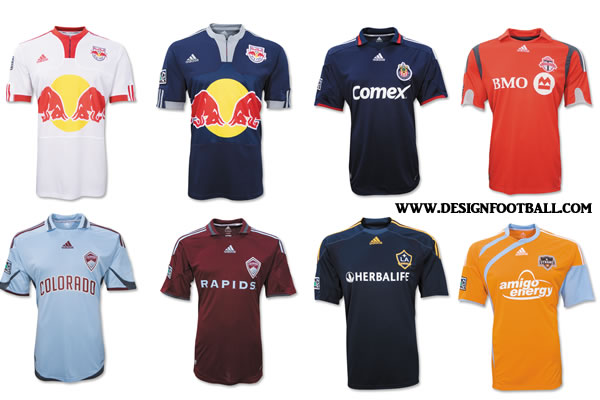
There's been some big, big news setting the football messageboards alight over the past few days. Yep, several Major League Soccer teams' kits for the 2009/10 season have been unveiled on FootballShirtCulture.com (Ka-who?). Always a day of note in the football calendar, it really hits home how adidas never fail to entirely incorporate into the playing wear of the forthcoming season a club's history and tradition. Or lack thereof.
Going through the shirts, firstly that of Canadian representatives Toronto FC, we see a futuristic design with a highly prominent sponsor and a crest typical of the league, apparently straight out of The Hurricanes. If these home and away shirts had any more features they'd be James Bond cars and whilst they resemble decent training tops they're not gonna get connoisseurs drooling (not that I can necessarily claim to be that).
The rest of the shirts have similarly bizarre constructions. Houston Dynamo had done ok previously with their Marseille orange third shirt ripoff but now with a new odd rotated collar and stripe design (I'm not gonna try to describe it, check it out) and one alternate coloured sleeve there's just too much going on. The template actually works well with a proper collar on the new Suwon Samsung Bluewings kit and may be a triumph on upcoming European teams' offerings but when coupled with the starry night cereal packet crest it's something of a horrorshow.
We'll brush over newbies Seattle and also Colorado. Their kits are ok. The badges will still leave traditionalists cold but all in all those designs are towards the top of a disappointing scale. Which is more than can be said for New York Red Bulls' adventurous number. If anyone fancies a new take on the triathlon that includes rugby alongside swimming and cycling then this is the kit for you. Incidentally, are they called New York Red Bulls or Red Bull New York? Try humming "Red Bull New York, New York Red Bulls" to the Pompey Chimes tune. Ha! Now you're in my purgatory too! Try getting that out of your head.
Ironically, possibly the most soulless of the MLS teams RBNY/NYRB (energy drink alert! ENERGY DRINK!) has one of the more authentic and classic seeming crests. However, the fact that it doubles up as the oversized sponsor doesn't help and, regardless, it will always be bettered by its Chivas USA counterpart. The reason being that Chivas have a history borne of their inspiration club Guadalajara of Mexico and an almost identical crest. Chivas' classic red, white and blue kit always works so that one will be worth waiting for.
So all in all a disappointment. Subtlety and restraint go a long way in kit design so we should abandon one or both with caution. As for the crests, America and Canada's cities have traditions and legacies more ancient than many of Europe's oldest teams so, although there are some examples of inspiration being taken in names and badges (I'm yet to be convinced in the case of Real Salt Lake) this can be incorporated in a much less cartoon-like manner. As Barack Obama reminded the US nation in his speech (seamless!), his country has much to remember and be proud of from its past and this should not be sacrificed in the pursuit of entertainment (the last bit was all me).
Going forward, if North America and adidas take the lead from the news that Manchester United will be updating a hundred-year-old design next season then MLS could gain still much-needed credibility. But as things stand my recommendation (for the little it's worth) for North American football/soccer apparel would be LA Galaxy home shorts printed with Beckham's 23 and a nice, old #9 CHINAGLIA New York Cosmos shirt. They're both a little bit of history.
So here we find ourselves in 2009. Happy New Year. I hope everyone got what they wanted for Christmas; I certainly did. Liverpool top of the league, Chelsea dropping points, Celtic winning at Ibrox (with the bonus of that allegedly adulterous Rangers-supporting swine Gordon Ramsay no doubt being banished to his shed to witness it) and finally my Christmas wouldn't have been complete without receiving an example of football design brilliance.
My (bespoke?) Liverpool/Marseille scarf went straight from the wrapping to my neck and that's where it stayed as I eschewed other presents. "Indoors" and what? I now need Celtic/Liverpool and Marseille/Celtic versions and three weeks' worth of 09/10 Marceltipool wintertime sideline elegance will be catered for.
But Christmas is also a time of turkeys. And not just the fat, stuffed variety that we consume. Every December 25th, kids and adults alike unwrap the current shirt of their favourite football team, regardless of whether it's a hit or a miss. There may only be five more months of guaranteed sycronicity with what the players are wearing but the football shirt/kit is a seasoned pro when it comes to the under-tree area. This season's aforementioned turkey is, in my mind, Manchester City's bright orange change number and surprisingly, despite the convenience of the poultry link, it's come from Le Coq Sportif.
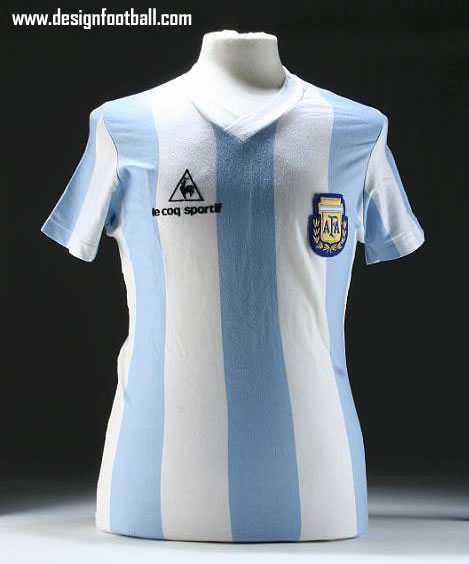
Le Coq Sportif has a distinguished history of sports, fashion and particularly football design. Success on the field has followed the brand from their comparitively early years when they manufactured the kit of the first French title-winning Olympique de Marseille team through to their supplying to Tottenham Hotspur - including FA Cup victories - and the Argentinian (x2) and Italian World Cup winning teams of 1978 through to 1986. They could claim to have been world champions for 12 consecutive years as a result.
